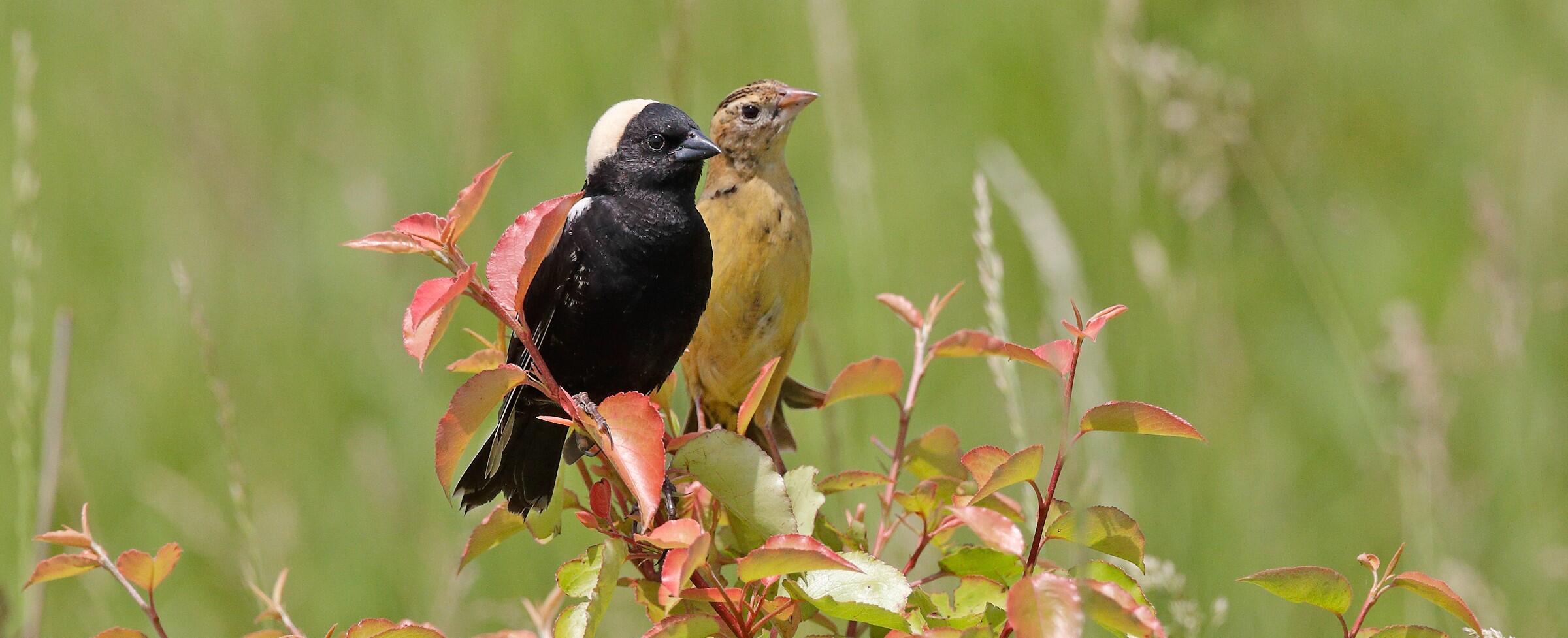
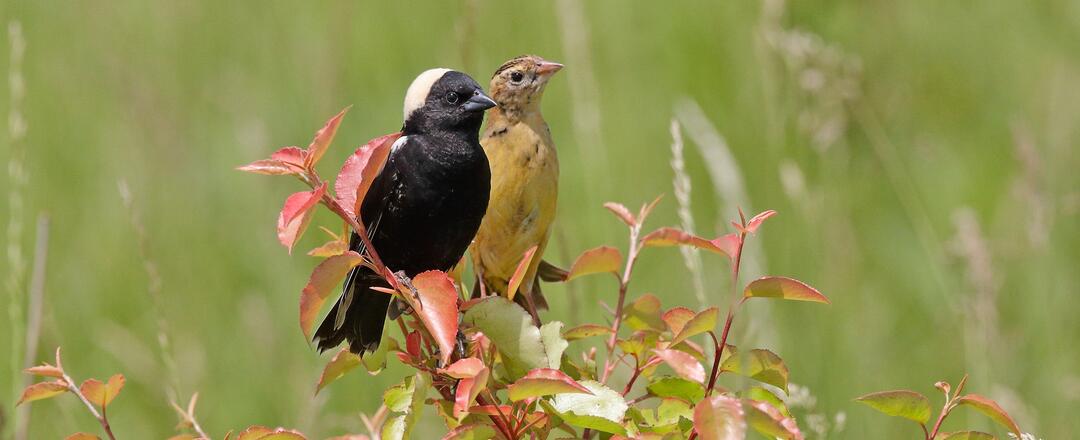


Bright and early on a mid-June morning, Audubon Vermont biologists and a Conservation AmeriCorps Member spread out across fields enrolled in the Bobolink Project to monitor for grassland birds. This project provides financial incentives to landowners to manage their fields for nesting grassland birds.
The tall grasses sway and the Bobolinks display around us as we walk our transects, calling out the birds we spot to one another. “Male Bobolink Recorded,” a voice announces from our tablet. This year, we tested a new mapping application to streamline data collection to not only track bird presence but also document habitat conditions. At one point, we pause to photograph a patch of Wild Parsnip (Pastinaca sativa). Non-native, invasive plants like these are encroaching on nesting areas, making the habitat less suitable for grassland birds. To combat this, new haying guidelines recommend mowing invasive plants before they go to seed, while still protecting these important grassland nesting birds.
Bobolinks, along with other grassland species such as Eastern Meadowlark, are especially vulnerable to hayfield management. Adjusting management practices is critical to ensure these populations thrive. The Bobolink Project offers financial incentives for two haying timelines that allow for these species to fledge from fields.
- Delayed First Cut: No disturbance in the field until July 15th
- Delayed Second Cut: No disturbance in the field between May 20th and July 24th
Bobolinks in 2025
This year in Vermont, 1,009 acres were enrolled by 23 landowners. During surveys of these enrolled fields, we observed 258 female Bobolinks and from this number we were able to estimate 722 fledglings. These numbers are similar to what we reported in 2024 when there were 935 acres enrolled in Vermont with an estimated 748 fledglings. Ideally, we'd hope to see an increase in acres enrolled also produce an increase in Bobolink fledglings. This slight decrease in fledglings could be an indicator of poor habitat quality, potentially due to encroaching non-native plants. Data like this helps us better understand the challenges Bobolinks face and informs our future habitat management strategies.
The Bobolink Project works across northern New England and New York to support farmers and landowners in adopting bird-friendly haying practices. An additional 391 acres of fields were enrolled in New York, Massachussets, New Hampshire, and Maine, further strengthening habitat availability and increasing the long-term success of grassland birds across the region.
Enroll in the Bobolink Project
Are you or someone you know interested in enrolling fields in the Bobolink Project? Applications for the 2026 field season are now open with options available both for with and without compensation. By participating, landowners play a direct role in grassland bird conservation. Applications are due on March 15th